A Routine Eye Surgery. A Devastating Outcome.
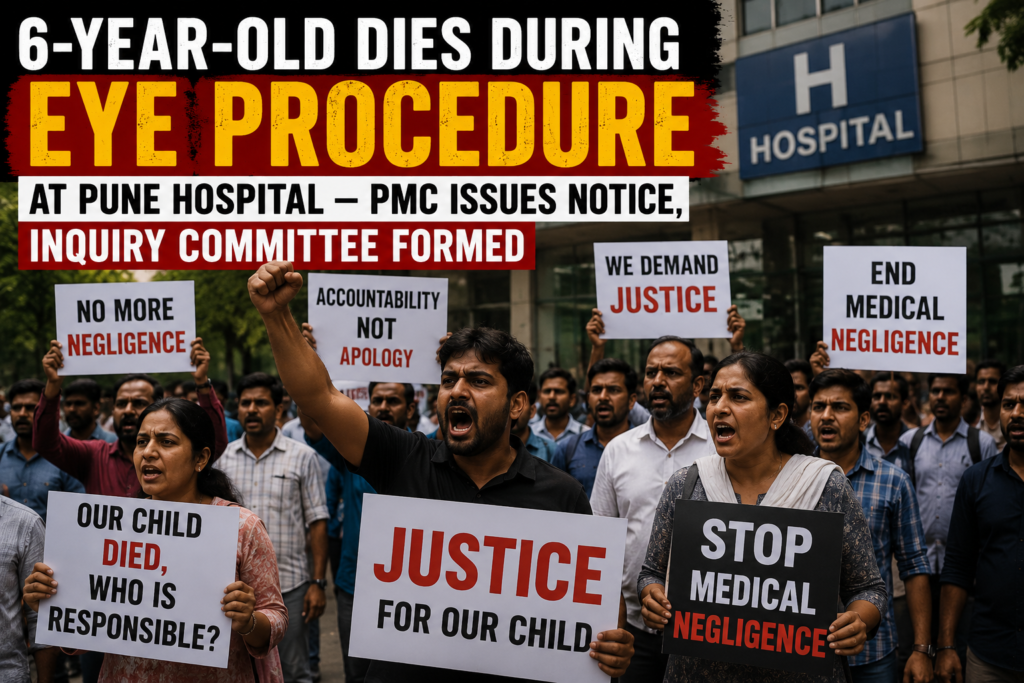
On the morning of May 18, 2026, a six-year-old girl named Priyansha was brought to Deenanath Mangeshkar Hospital, Pune for what was expected to be a routine eye procedure.
Her father, Bagade a mason from Ahilyanagar had done everything right. He had taken her to a local clinic in Shirur when her vision started getting worse. The clinic suspected glaucoma and referred them to Deenanath Mangeshkar Hospital, where a consulting ophthalmologist could treat her. The family completed all pre-surgery medical tests on May 14 and 15. She was declared medically fit for surgery on May 18.
By 8 AM, Priyansha was taken into the operation theatre in a completely normal condition.
Within half an hour, the doctor called her father inside.
She had coughed up blood. Her heart had stopped.
Despite being immediately shifted to the ICU, Priyansha was declared dead at 11:30 AM.
What the Family Alleges
The family has filed a formal complaint with Alankar Police Station, alleging medical negligence.
Their core question to the hospital is this: How does a minor eye procedure result in internal bleeding and cardiac arrest in an otherwise healthy child?
The family alleges that an incorrect dose of anaesthesia may have triggered the fatal chain of events. They point out that Priyansha had been certified as fully fit for surgery just days before — making the sudden deterioration impossible to explain without a thorough investigation.
Protesters from the Shinde faction of Shiv Sena also gathered outside the hospital in the days following the incident. Prakash Dhamdhere, City Chief of the Medical Assistance Cell in Pune, called the death “extremely unfortunate and shocking” and demanded a detailed and impartial investigation. Protesters sought ₹50 lakh in compensation for Priyansha’s family and called for a complete audit of the hospital’s medical systems.
⚠️ Important Note: These are allegations made by the family and protesters. The investigation is currently ongoing, and no court has issued a finding of negligence at this stage.
Hospital’s Response
Deenanath Mangeshkar Hospital has called the incident “extremely unfortunate” and stated that an internal inquiry has been initiated.
The hospital maintains that:
- The child had a complicated pre-existing eye condition
- All necessary medical protocols and procedures were followed
- The medical team took appropriate precautions given the complexity of the case
- The hospital has denied allegations of negligence
The hospital has also assured complete transparency and said all relevant documents and information will be shared with police and the administration of Sassoon General Hospital.
Regulatory Action: PMC Steps In Fast
What makes this case particularly significant from a regulatory standpoint is how quickly the authorities responded.
May 18 – Priyansha passes away during the procedure.
May 20 – The Pune Municipal Corporation (PMC) issued a show-cause notice to Deenanath Mangeshkar Hospital, directing it to submit all case papers and medical records to the civic health department within 24 hours. PMC Assistant Health Officer Dr. Suryakant Devkar confirmed the notice was issued.
May 23 – PMC constituted a four-member inquiry committee to investigate the incident. The committee has been directed to conduct a preliminary inquiry and submit a detailed report within seven days.
The case is simultaneously being investigated by:
- 🏛️ Alankar Police Station – on the family’s criminal negligence complaint
- 🏥 PMC Health Department – following the show-cause notice
- 🔍 PMC Inquiry Committee – for a detailed preliminary investigation
A Hospital That Has Faced Scrutiny Before
This is not the first time Deenanath Mangeshkar Hospital has found itself in the spotlight.
Earlier this year, the hospital faced serious controversy when a pregnant woman, Tanisha Bhise, was allegedly denied emergency admission over a ₹10 lakh deposit demand. She later died at another facility after giving birth to twin daughters. The Sassoon General Hospital inquiry panel found that the hospital had violated norms applicable to charitable hospitals, which prohibit demanding advance payments in emergency cases. The hospital was found guilty and recommended for action to the Charity Commissioner.
The back-to-back nature of these incidents raises broader questions about accountability, internal oversight, and the protection available to healthcare providers when things go wrong.
What Every Doctor and Hospital Should Take Note Of
This case is still unfolding. We are not drawing conclusions about the guilt or negligence of any doctor or the hospital — that is for the investigation and courts to determine.
But here is what every doctor and medical establishment in India should be paying attention to:
1. Regulatory scrutiny is fast and forceful. PMC issued a notice within 48 hours of the incident. A committee was formed within 5 days. Hospitals can find themselves in a full-scale regulatory storm before the medical facts are even established.
2. Anaesthesia-related claims are among the most legally complex. When a patient deteriorates under anaesthesia, the clinical explanation is often highly technical — but the legal and public narrative moves much faster than the science. Doctors in specialties like anaesthesia, ophthalmology, and surgical care face significant exposure.
3. Pre-existing conditions are not a blanket legal shield. The hospital has stated the child had a complicated pre-existing eye condition. While this is medically relevant, it does not automatically resolve a negligence claim — especially when the patient had been cleared as “fit for surgery” just days before.
4. Protests and media pressure arrive before legal proceedings. By the time any court examines this case, the doctor and hospital will already have faced public protests, media coverage, and regulatory notices. This reputational and operational exposure is real — regardless of the eventual legal outcome.
A Note from LiableCover
At LiableCover, we work exclusively with doctors and medical establishments. We are not here to blame healthcare professionals – we understand that medicine is complex, pressure is high, and outcomes are sometimes tragic despite everyone’s best efforts.
But cases like this one show clearly that legal and regulatory exposure can arrive in days, not months. And when it does, you need to be protected.
Professional Indemnity (PI) Insurance for Doctors and Medical Establishment (ME) Insurance ensure that when the unexpected happens:
- You have legal representation from Day 1
- Investigation costs are covered
- Compensation claims, if upheld, are handled by the insurer
- Your focus can remain on medicine – not on legal battles
This case is developing. We will continue to update you as the PMC inquiry report is submitted and legal proceedings progress.
📩 Talk to our experts: liablecover.com 📰 Stay updated every week: blogs.liablecover.com 🎙️ Join the conversation: liabletalk.liablecover.com
Sources: Free Press Journal, Medical Dialogues, Pune Pulse, Punekar News, The Bridge Chronicle Case Status: Under investigation by PMC Inquiry Committee — Report expected within 7 days of May 23, 2026