What Happened
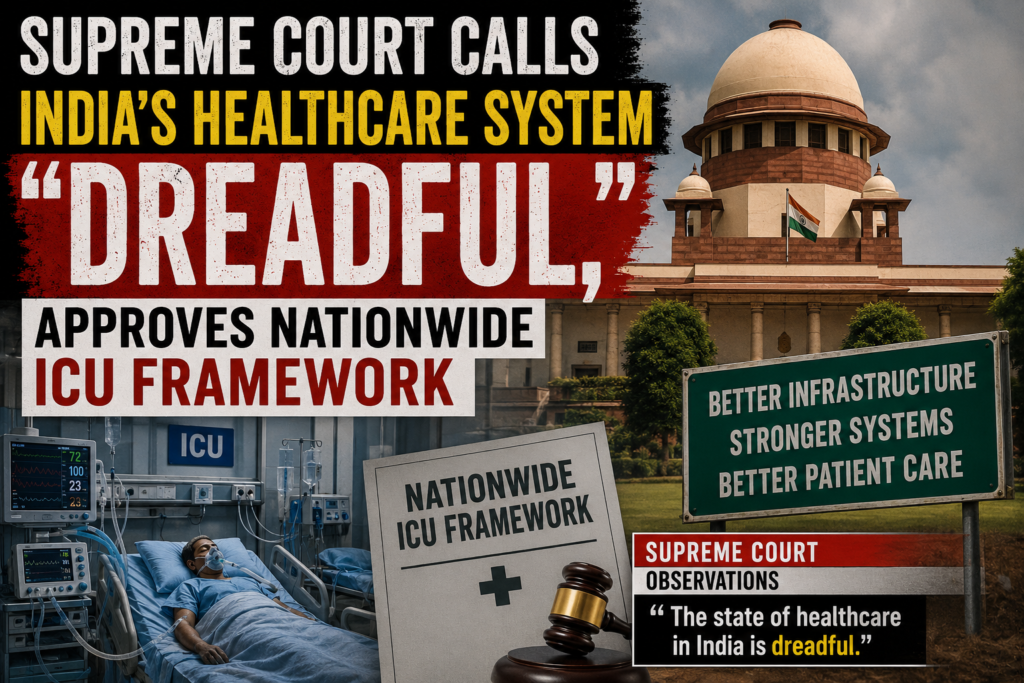
In a landmark order that every doctor and hospital administrator in India must pay attention to, the Supreme Court on May 20, 2026 approved a nationwide three-tier ICU framework a comprehensive set of minimum standards for intensive care units and critical care services across the country.
The bench did not mince words about the current state of India’s healthcare infrastructure. It observed that India today is in a “dreadful position” where the population is increasing rapidly but the health system is failing to keep pace, let alone provide quality care.
This case, which began in 2016 over alleged medical negligence in private hospitals, evolved into something far bigger: a court-monitored national effort to standardise ICU infrastructure from ground up.
The Three-Tier ICU System What Does It Mean?
The court approved a structure that classifies ICUs across India into three levels each with defined minimum standards for staffing, infrastructure, equipment, hygiene, and patient care protocols.
Think of it like this:
- Level 1 ICU — Basic critical care; the starting point for smaller facilities and district hospitals
- Level 2 ICU — Intermediate care with more specialised staffing and equipment
- Level 3 ICU — Advanced critical care; full-service ICU with specialist availability and complete monitoring systems
Every state has been directed to first conduct a gap assessment within two months essentially an audit of where their hospitals currently stand versus where they need to be and then formulate an implementation plan beginning with Level-1 ICUs.
Key Directions from the Supreme Court
Here is what the court has ordered and what hospitals and medical establishments must begin tracking:
For State Governments:
- Complete a gap assessment of existing ICU infrastructure within two months
- Formulate implementation plans for minimum ICU standards
- Explore CSR and NGO funding for ICU upgrades
- Maintain at least five fully equipped ventilator ambulances for patient transfers
For the Union Government:
- Develop a nationwide GPS-based system to map all healthcare institutions
- Build a network for seamless patient transfers and inter-hospital coordination
- Introduce public display systems at hospital entrances showing real-time ICU bed availability
- Create a national telemedicine grid tele-ICU and teleconsultation
Next hearing: August 13, 2026 all state health departments must file affidavits with compliance status before this date.
The Nursing College Shock
One of the more striking observations in the order concerned nursing education and it has direct implications for hospitals.
The Court was informed that nursing colleges are currently allowed to operate even when the affiliated hospital with ICU facilities is up to 30 kilometres away.
The bench’s reaction? “We are surprised and shocked as to how such stipulations exist.”
The Court’s position: nursing students who will ultimately work in ICUs cannot be trained properly in institutions located so far from real patients and real equipment. The court has directed the Union government to revisit these norms and present revised recommendations — failing which the Court has indicated it may issue its own interim directions.
What This Means for Doctors and Hospitals The LiableCover View
This Supreme Court order is not just a policy statement. It has very real, very practical implications for every doctor and medical establishment in India — especially those running or working in ICUs and critical care settings.
1. Compliance is now court-monitored. This is not a government circular that gets filed and forgotten. The Supreme Court is actively monitoring implementation. States will be required to file affidavits. Non-compliance will be visible at the highest level.
2. Infrastructure gaps create liability gaps. If a patient deteriorates or dies in an ICU that does not meet the minimum standards the court has now formalised, that gap becomes directly relevant in any negligence claim or consumer forum dispute. “We were doing our best with what we had” is a weaker defence when a clear national standard now exists.
3. Tele-ICU and telemedicine are no longer optional. The court has explicitly endorsed and encouraged tele-ICU integration. For hospitals that have been slow to adopt remote monitoring or teleconsultation — especially in smaller towns and Tier-2 cities — this is a strong judicial signal that the standard of care expectation is moving in that direction.
4. Ventilator ambulance protocols will matter in negligence cases. The direction to maintain at least five ventilator ambulances per region is relevant not just operationally but legally. If a patient was not transferred in time due to lack of equipped ambulances, this will become a point of scrutiny.
5. The definition of “standard of care” just got clearer — and higher. Every medical negligence case in India turns on the question of whether the doctor or hospital met the applicable standard of care. With a court-approved national framework now in place, that standard is no longer ambiguous. This raises the bar — and the exposure — for all of us in the healthcare sector.
A Note from LiableCover
The healthcare sector in India is under more legal and regulatory scrutiny than ever before. From Supreme Court-monitored ICU standards to judicial rulings on how institutions treat their own staff — the environment is changing fast.
As doctors and medical establishments, you cannot afford to only be great clinicians. You also need to be legally aware and institutionally protected.
That’s exactly what we are here for.
Professional Indemnity (PI) Insurance for Doctors and Medical Establishment (ME) Insurance are not just about covering compensation claims. They are about ensuring that when regulators, courts, or patients come knocking you are not facing it alone.
📩 Talk to our experts: liablecover.com 📰 Stay updated every week: blogs.liablecover.com 🎙️ Join the conversation: liabletalk.liablecover.com